
Bank Notes
When a Brumder signature meant real United States currency
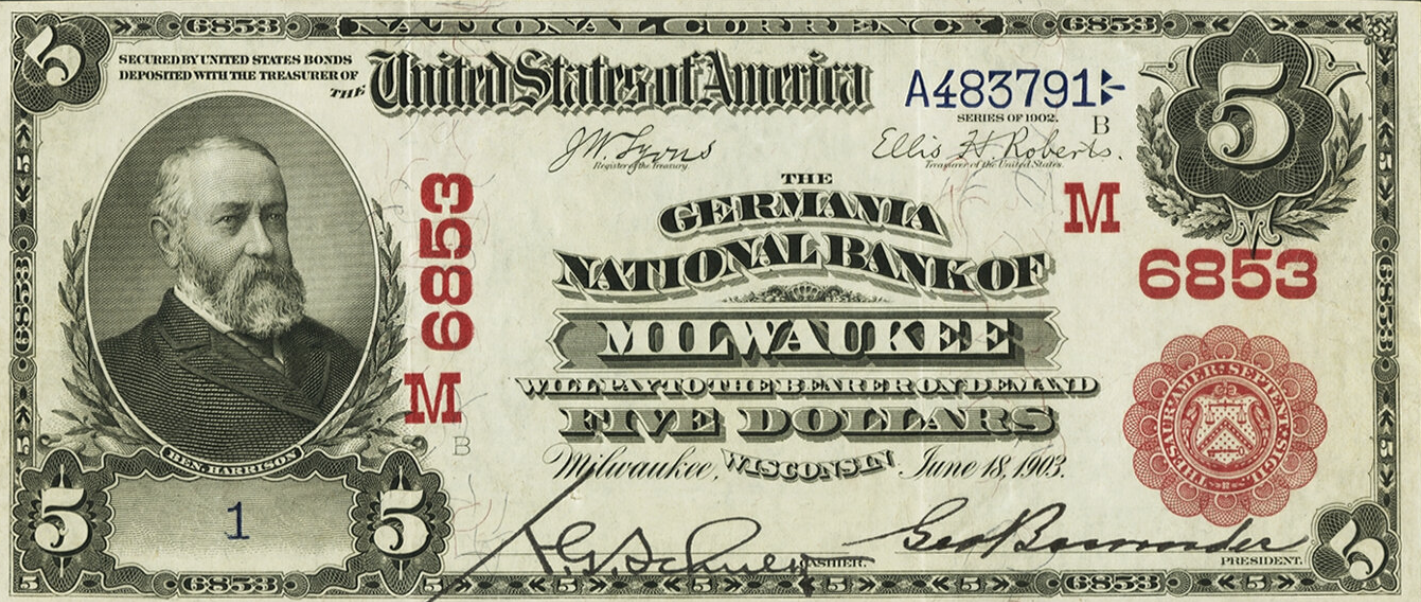
By 1903, George Brumder had spent nearly four decades building the largest German-language publishing house in the United States. That same year, his name also appeared on money. This is a genuine Series of 1902 Five-Dollar National Currency bank note, issued by the Germania National Bank of Milwaukee and hand-signed by George Brumder himself as the bank's president.
A Bank with the Power to Print Money
Under the National Banking Acts of 1863 and 1864, the United States created a system of nationally chartered banks that were empowered to issue paper currency, backed by United States government bonds the bank deposited with the Treasury. A chartered bank could put notes into circulation worth up to 90 percent of the bonds it held as collateral, and the federal government backed the value of every note. From 1863 to 1935, thousands of national banks across the country issued this currency, each note bearing the issuing bank's own name, charter number, and the signatures of its officers.
The Germania National Bank of Milwaukee received federal charter number 6853, the last German-titled national bank to be chartered in Wisconsin. George Brumder served as its president from 1903 until his death in 1910. As president, he was one of two bank officers whose hand-signed names gave each note its authority to circulate as money.
Reading the Note
Look closely at the front of the note and the story of Brumder's authority is written right into the design:
- "THE GERMANIA NATIONAL BANK OF MILWAUKEE" is printed across the center, the bank's own title set in large shaded type, exactly as the National Bank Note system required.
- The large red 6853 on both sides is the bank's federal charter number, the mark that distinguished it from every other national bank in the country.
- The red letter M indicates the issuing region, the Midwest, a sorting aid added to later large-size notes to help Treasury workers route returned currency.
- At the lower right is the ink signature "Geo. Brumder", as president; at the lower left, H. G. Schwalbe, as cashier. These two signatures were applied by hand before the note was released into circulation.
- The oval portrait at left is of Benjamin Harrison, the 23rd President of the United States, a common choice for the $5 denomination of the era.
- The date line reads Milwaukee, Wisconsin, June 18, 1903, placing the note squarely within Brumder's presidency of the bank.
What Made It Real Money
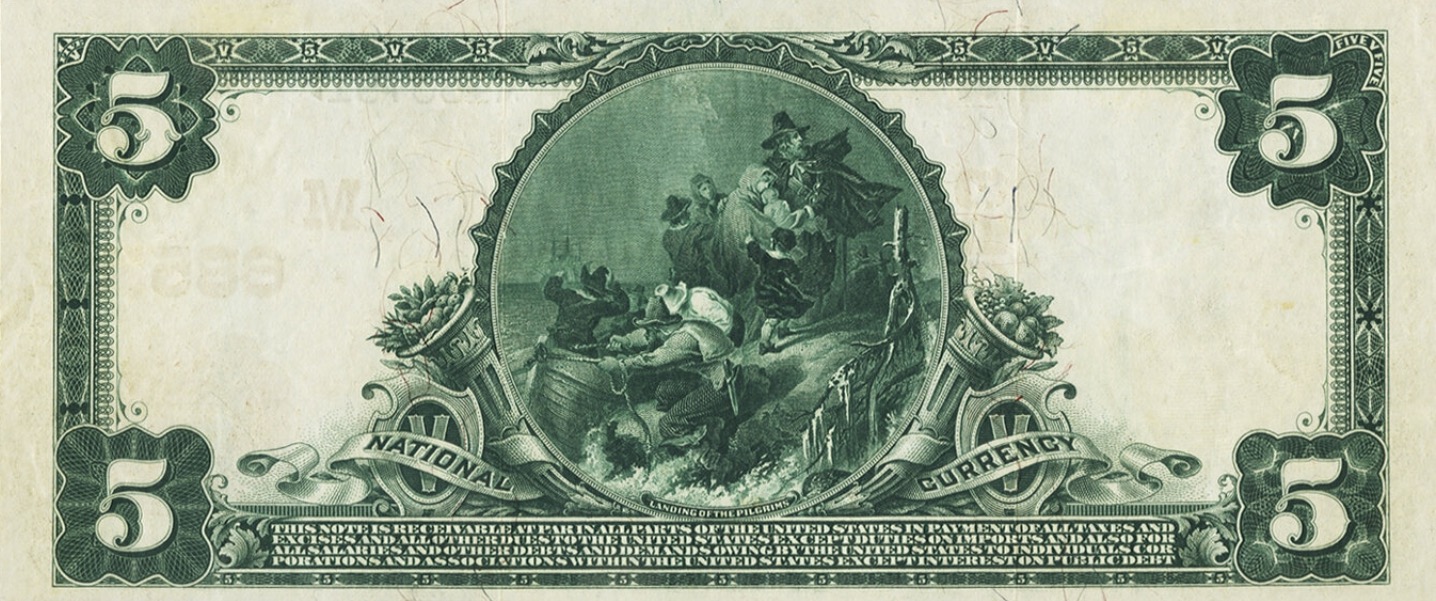
A note like this was not a private token or a store coupon. It was United States currency. The Bureau of Engraving and Printing produced the notes, and the Treasury held the bonds that backed them. When a holder presented the note, it could be redeemed, and the bank was required to keep a redemption fund equal to five percent of its outstanding notes in gold or other lawful money. The notes were accepted for nearly all payments to and by the federal government. In short, George Brumder's signature on this bill carried the full weight of the United States banking system behind it.
From Germania to Commerce
The Germania name did not survive the First World War. As anti-German sentiment rose in 1918, every German-titled national bank in Wisconsin dropped "German" from its name. The Germania National Bank of Milwaukee became the National Bank of Commerce of Milwaukee, and the Germania Building on West Wells Street was renamed the Brumder Building, a name it kept until a 1981 renovation restored the original. The notes, however, survived as artifacts of an era when a Milwaukee publisher's name, signed in ink, meant five dollars in the hand of any citizen who held it.
In His Own Hand
George Brumder signed this note not as a publisher or a newspaperman, but as a bank president vested by the United States government with the authority to issue currency. It is a small piece of paper, and a large piece of family history.
From the pressroom to the treasury vault,
a Brumder signature once spent as cash.